REVIEW · KATHMANDU
Everest Base Camp Tour & View Point by Helicopter from Katmandu
Book on Viator →Operated by Himalayan Mentor · Bookable on Viator
That blue-and-white world above the clouds has a sound. This Everest Base Camp helicopter tour is a fast way to chase Everest views without the days of trekking, with flight time built around Kalapatthar and Everest Base Camp.
What I like most is how the plan is shaped by real high-altitude limits, not wishful thinking. The route includes a fuel stop, a group split near Pheriche, and then overflights of Kala Patthar (5,545m) and Everest Base Camp (5,364m) for the big moments.
There is one key drawback to consider: this is weather-dependent, and the higher you go, the more the operation has to follow strict limits, including a passenger weight cap and a small group structure.
In This Review
- Key Points Before You Go
- How This Everest Helicopter Tour Really Works
- Helicopter, Group Size, and the Pace You’ll Feel
- Early Morning at TIA Domestic Terminal (6:15am Start)
- Fuel Stops and Why Lukla Shows Up
- The Pheriche Split: When Altitude Caps Who Gets Closer
- Kala Patthar and Everest Base Camp: The Main Views at 5,545m and 5,364m
- Syangboche (3,870m) and Optional Breakfast at Everest View Hotel
- Kathmandu Return and the Reality of High-Mountain Weather
- Price and Value: Is $1,800 Worth It?
- What to Pack and How to Prepare for a Mountain Flight
- The Logistics Touch: Why Kesh and Himalayan Mentor Matter
- Who This Tour Fits Best (and Who Should Rethink It)
- Should You Book This Everest Base Camp Helicopter Tour?
- FAQ
- Where does the helicopter tour start in Kathmandu?
- What time does the tour depart?
- How long is the tour?
- Which places does the helicopter fly to or over?
- Is breakfast at Everest View Hotel included?
- How many passengers are in a group?
- Is there a weight limit?
- What happens if weather is bad?
Key Points Before You Go
- Small group, big access: You fly with a capped group size (maximum 5 travelers) and a pilot in a shared helicopter setup.
- Kala Patthar and Everest Base Camp overflights: The flight is specifically routed to give you the best views of Everest from two iconic elevations.
- Altitude realities at Pheriche: The group can be split so only up to 3 passengers can go into the Everest Base Camp / Kalapatthar section.
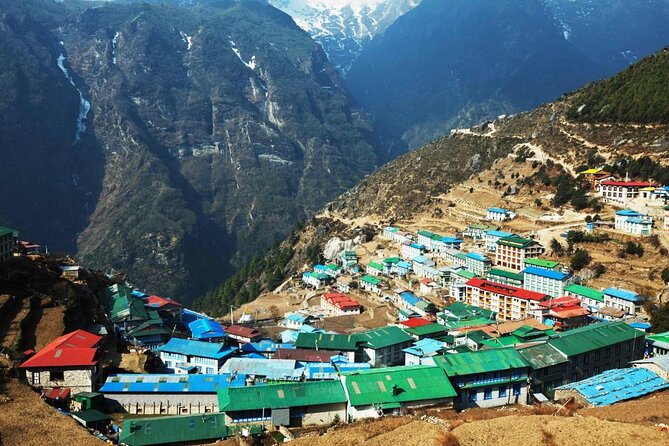
- Syangboche landing at Everest View Hotel: You land at 3,870m and can add an optional breakfast with panoramic mountain views.
- Fuel stops are part of the experience: Lukla is used for fuel handling, so expect short stops rather than a nonstop hop.
How This Everest Helicopter Tour Really Works
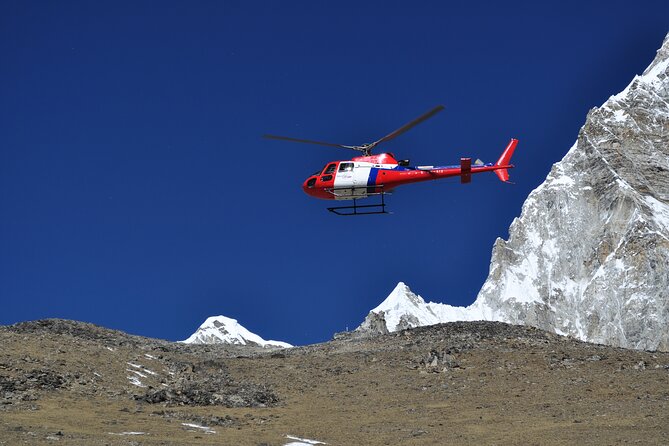
This tour is designed for people who want the Everest feeling, but don’t want to spend weeks walking to it. The core idea is simple: you leave Kathmandu early, fly to the Khumbu region, spend your short “on top” time in the highest-impact sightseeing zones, then return the same morning. With a total duration of about 3 hours 55 minutes (including the full routing), it’s one of the more time-efficient ways to see Everest up close.
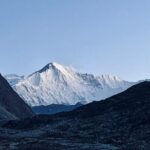
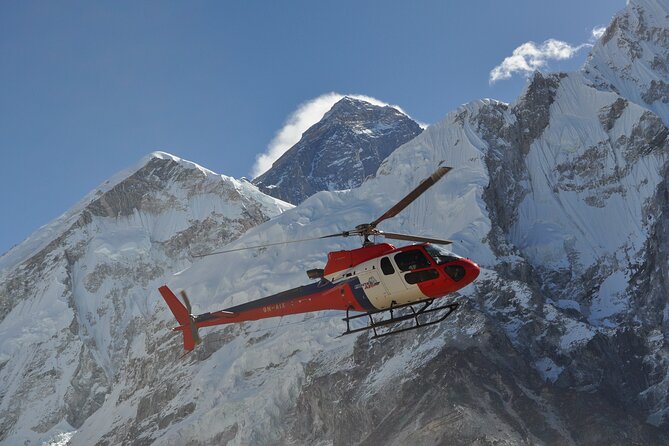
The flight itself is the headline. You’re not just looking at Everest from afar. The routing is built around two view anchors: Kala Patthar at 5,545m and Everest Base Camp at 5,364m. Those are famous for a reason. One gives you a dramatic, towering perspective; the other connects you to the myth and the reality of the trekking route.
I also like the practicality of how the tour handles logistics. For example, there’s an early departure from the domestic terminal and a clear set of stops for fuel and altitude management. It feels less like a “tour” and more like an aviation plan with sightseeing attached.
You can also read our reviews of more tours and experiences in Kathmandu

Helicopter, Group Size, and the Pace You’ll Feel
You’ll fly in a group-sharing setup with up to 5 passengers and a pilot. That small headcount matters. In a helicopter, you want fewer bodies and fewer moving parts. Less crowding usually means you can actually pay attention to what you’re flying over, not just where everyone else is craning their neck.
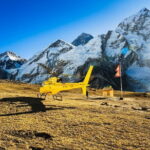
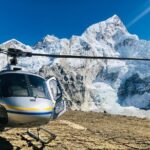
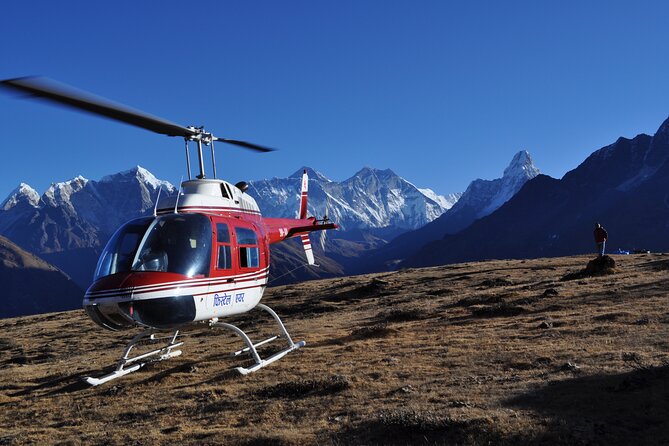
Your ride is also tied to a specific aircraft model mentioned for the operation: an Eurocopter 350 B3. That’s useful context because it hints at what kind of experience to expect in terms of comfort and the way the flight is paced.
And pace matters in Nepal’s mountains. This tour is short, but it’s not casual. You’re moving through high terrain fast, and that means the operation has to follow the rules of altitude, weight, and weather.
Early Morning at TIA Domestic Terminal (6:15am Start)
The day begins at 6:15am at the TIA Domestic Terminal parking lot in Kathmandu. If you’re staying in Thamel or the tourist districts, this is early enough that you’ll want to be organized the night before. Bring your documents and keep your plans simple. This tour gives you one shot at the flight window, so you don’t want anything small to become a big delay.
You’ll have hotel pickup and drop-off, which is a real quality-of-life upgrade. Getting to the domestic terminal on your own can be easy or chaotic depending on traffic and timing. With pickup offered, you can shift your energy from logistics to simply being ready.
From the start, the schedule is built around flight time and short stops. The itinerary also suggests you’ll be close to the helicopter operation flow right away, which means you should assume there will be waiting, checks, and a bit of hurry during boarding.
Fuel Stops and Why Lukla Shows Up
One surprising thing is that your flight doesn’t go straight from Kathmandu to the sightseeing points. There’s a stop in Lukla early on for fuel handling, and then another Lukla stop later for refill.
Why this matters for you: fuel stops are not a detour done to waste time. They’re part of how the routing stays possible for the aircraft. That means your overall sightseeing time stays protected, even if you’re waiting briefly at intermediate stops.
At Lukla, the stop is listed as about 10 minutes. Think of it as a short operational pause. You’ll likely spend more time seated and braced for boarding than walking around. If you’re hoping to turn this into a stretch-and-snack stop, set expectations low. This is an air-first experience.
The Pheriche Split: When Altitude Caps Who Gets Closer
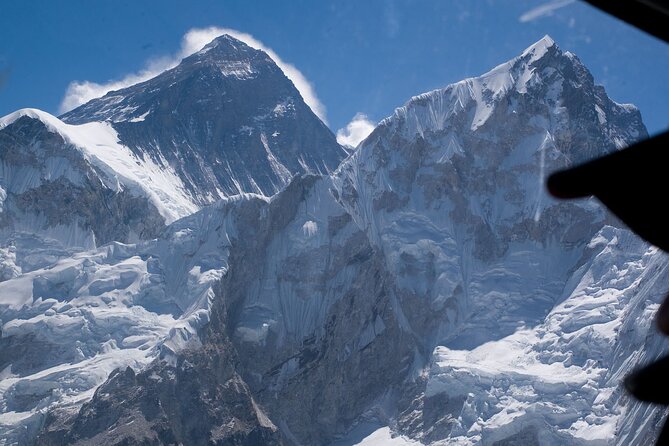
The most important operational detail in the plan is what happens at Pheriche (on the route toward Dughlha Road). At that point, the group is split. The stated reason is altitude and capacity limits: only up to 3 passengers can go into the Everest Base Camp section and Kalapatthar due to thin air.
This is the part you should mentally prepare for, because it changes what “your” experience looks like compared to “everyone’s” experience. If you’re traveling as a group of friends, it’s worth realizing that the plan is built around a cap. That means not every passenger may be placed in the same position for the highest-altitude viewing segment.
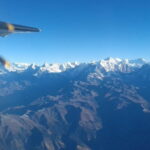
Now, you can still expect Everest views during the flight. The description clearly says you’ll see the Himalayan region from the air and have flyovers of Kala Patthar and Everest Base Camp. But the split tells you that access to the closest/highest segment is limited.
If you’re the kind of traveler who needs a guaranteed, identical experience for every minute, this is the one “trade-off” to accept. It’s not a flaw in the tour. It’s how the operation stays within safe altitude limits.

Kala Patthar and Everest Base Camp: The Main Views at 5,545m and 5,364m
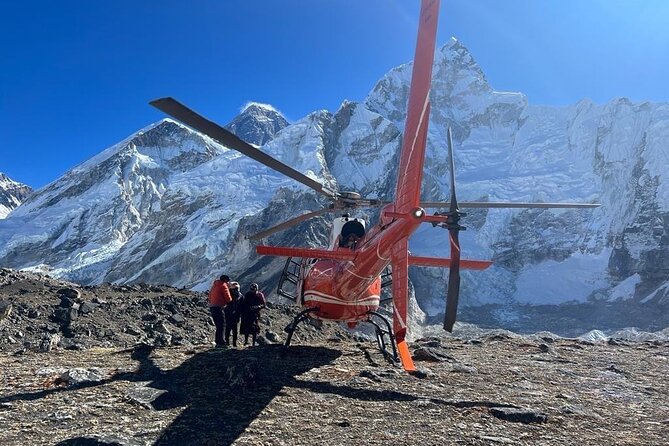
The flight is structured so the major moments happen around Kala Patthar (5,545m) and Everest Base Camp (5,364m). These two points are not random. They represent different ways of reading the mountain.
Kala Patthar is famous for how it frames Everest. When you get higher, your perspective changes: peaks feel closer, and the terrain has more “layers” in the view. That’s exactly what you want in a short helicopter window.
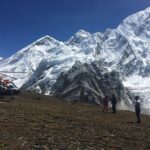
Everest Base Camp is the other anchor. Even if you’re not trekking there on foot, the overflight connects you to the scale of the expedition region. From above, you can get a sense of glacial shapes and the Khumbu geography in a way that ground-level shots often miss.
The tour description also says you’ll see aerial views of glaciers and the Khumbu Region. In a helicopter, glaciers don’t just look like texture. They look like motion and structure, with creases and flows that are hard to appreciate from roads.
And you’ll have flyovers that are designed around visibility: the plan says Kalapatthar and Everest Base Camp flyover moments are where the views are best, so you’re not simply passing through them. You’re there in the flight profile on purpose.
Syangboche (3,870m) and Optional Breakfast at Everest View Hotel
After the base camp and Kala Patthar segments, the route continues to Syangboche (3,870m), where you land at the Everest View Hotel area. From there, the tour offers an optional chance to enjoy breakfast in front of the Himalayan range.
This is a smart inclusion for a short tour. The breakfast isn’t the “value” in itself, it’s the pause. It gives you a grounded moment after the fast helicopter viewing. You can look, breathe, and actually take in the view without a rotor schedule running in the background.
It’s also a practical weather buffer in a way. Helicopter flights can change in routing and timing based on conditions, but landing at Everest View Hotel suggests the operation often has a defined window to let you see the mountains from a stable spot.
If you like photos, this part helps. It gives you a “stand still” opportunity. In a helicopter, you’re watching through a window with limited time. At the hotel, you can linger longer.
If you don’t want breakfast, you can still treat this as a scenic landing moment. Just remember breakfast is optional, not automatic.
Kathmandu Return and the Reality of High-Mountain Weather
After Syangboche, you return via another Lukla fuel stop and then fly back to Kathmandu. The whole day stays within a short window, which is part of why it works for many itineraries around Nepal.
But there’s a reality check you should factor in: the experience requires good weather. That means the mountains can be “right there” on the map and still be hidden in cloud or fog. The operation can be affected by weather conditions, and when that happens, you should expect flexibility in dates. The tour data states that if it’s canceled due to poor weather, you’ll be offered a different date or a full refund.
This is why I think it’s best to book when you can keep your schedule soft. If Everest is your one must-see moment in Nepal, build a bit of slack so weather doesn’t force a rushed scramble.
Price and Value: Is $1,800 Worth It?
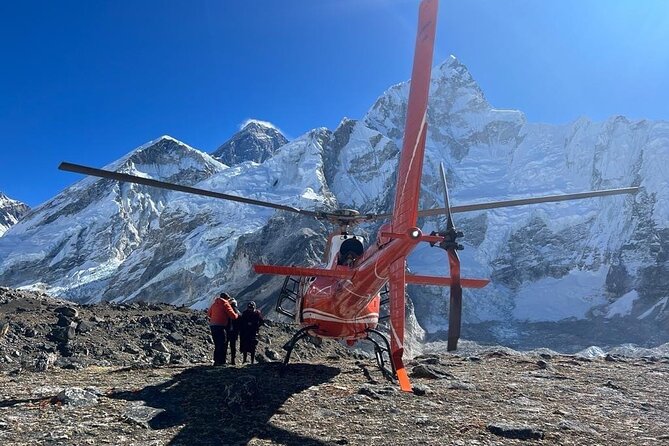
At $1,800 per person, this is not a “budget” experience. But value is not only about saving money. It’s about buying time, reducing strain, and still getting the iconic sightlines.
Here’s what you’re paying for, based on what’s included:
- a helicopter flight in a group-sharing setup (up to 5 passengers + pilot),
- hotel pickup and drop-off,
- fuel surcharge coverage.
What’s not included matters too:
- optional breakfast at Everest View Hotel,
- travel insurance and emergency evacuation cost,
- Everest National Park Permit & Municipality fee,
- airport tax.
To judge value, I’d compare two kinds of costs: money and time. Trekking to Everest Base Camp isn’t just expensive in a different way. It consumes days, requires training, acclimatization, and logistics. This helicopter tour buys a “best-of” Everest experience inside a morning window. If your schedule in Nepal is tight, that time savings is the real value.
Also, consider that this tour targets specific view points, not generic “Everest area” flying. The routing explicitly focuses on Kala Patthar and Everest Base Camp at altitude.
The price feels more reasonable when you put it in the context of:
- a limited group size,
- the specialized aircraft operation,
- and the fact that weather can still impact outcomes.
In other words: it’s pricey, but it’s not vague. You’re not paying for a bus ride and a hope. You’re paying for a high-stakes aerial plan.
What to Pack and How to Prepare for a Mountain Flight
The tour data is light on packing specifics, but the essentials are clear from the operating constraints.
First: you need to respect the weight limit. Total weight per passenger is listed as 176 lbs. If you’re near that range, plan carefully. In these operations, limits are not negotiable.
Second: assume cold and altitude exposure, even though you’re only in the high zone briefly. The helicopter window can feel like an indoor-outdoor change, and at altitude your body reads temperature differently.
Third: keep your morning calm. This is not a start-late activity. It’s a tight schedule that begins at 6:15am and runs through defined stops. A smooth start makes the rest of the flight feel magical instead of stressful.
Finally, do your homework on permits and fees. The Everest National Park Permit & Municipality fee are not included in the tour price as listed, and airport tax isn’t included either. That can change what you ultimately pay, depending on your situation and how your booking is structured.
The Logistics Touch: Why Kesh and Himalayan Mentor Matter
One of the strongest signals from the experiences shared about this operator is the quality of coordination. The name Kesh comes up in the planning stories, and what stands out is how proactive he was with communication. When logistics are complex, fast answers and clear expectations make the difference between a fun surprise and a stressful morning.
There’s also a theme of transparency: the planning is described as clear about what to expect. That matters for a helicopter tour because you’re trusting the route, the timing, and the weather window. When an organizer explains the plan plainly, you can relax enough to actually enjoy the flight.
So while the helicopter is the headline, the “how it’s managed” part is a real value component too. For an experience this expensive, I’d rather spend my money on something organized than something improvisational.
Who This Tour Fits Best (and Who Should Rethink It)
This is a great fit if you:
- want an Everest moment with minimal time in transit and on feet,
- care more about view and geography than trekking day-by-day,
- can handle a short, weather-driven schedule.
It’s also a good choice if your Nepal trip includes Kathmandu sightseeing and you want to add one “big ticket” mountain experience without extending your trip by a week.
I’d rethink it if you:
- need identical treatment for every member of your group, because the tour can split passengers at Pheriche with only 3 passengers able to go into the Everest Base Camp / Kalapatthar section,
- are relying on this to happen no matter what, because weather is explicitly required and can lead to cancellation with options,
- have a hard budget, since $1,800 is a major spend and several fees are not included.
Should You Book This Everest Base Camp Helicopter Tour?
If your goal is a fast, high-impact Everest experience, this tour makes sense. The route is built around the two most famous view points in the Everest orbit—Kala Patthar and Everest Base Camp—and you also get a meaningful stop in Syangboche at Everest View Hotel for panoramic views and optional breakfast.
I’d book if you can keep your schedule flexible and you’re comfortable with the reality that altitude limits can change who gets closest during the higher segments. I’d also book if you value organization and clear communication, since that part seems to be a strength tied to how the operation is run.
If you want a once-and-done trek, this won’t replace that. But if you want the Everest wow-factor inside one morning, this is exactly the kind of experience that can make a Nepal trip feel complete.
FAQ
Where does the helicopter tour start in Kathmandu?
The tour starts at the TIA Domestic Terminal parking lot in Kathmandu.
What time does the tour depart?
The start time listed is 6:15am.
How long is the tour?
The duration is about 3 hours 55 minutes (approx.), with flight time listed as about 3 hours.
Which places does the helicopter fly to or over?
You fly from Kathmandu, stop in Lukla for fuel, reach the Pheriche area, fly over Kala Patthar (5,545m) and Everest Base Camp (5,364m), continue to Syangboche (3,870m) to land at Everest View Hotel, then stop again in Lukla for fuel before returning to Kathmandu.
Is breakfast at Everest View Hotel included?
Breakfast at Everest View Hotel is optional and not included.
How many passengers are in a group?
The helicopter flight is described as group sharing with a maximum of 5 travelers and a pilot.
Is there a weight limit?
Yes. The total weight per passenger is listed as 176 lbs.
What happens if weather is bad?
The experience requires good weather. If it’s canceled due to poor weather, you’ll be offered a different date or a full refund.